

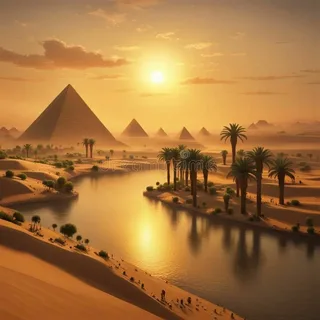
When people think of ancient civilizations along the Nile, Egypt usually comes to mind first. Its pyramids, pharaohs, and temples have dominated history books, documentaries, and museum collections for generations. Yet just south of Egypt, another remarkable civilization flourished for thousands of years. The kingdoms of Nubia built cities, ruled vast territories, traded across continents, and even conquered Egypt during one of the most remarkable chapters in African history.
Far from being a minor neighbor, Nubia developed its own traditions, languages, religious practices, and architectural achievements. Its rulers controlled valuable trade routes linking central Africa with the Mediterranean world, making the region wealthy and strategically important. Although modern archaeology has uncovered extraordinary monuments and artifacts, the Nubian kingdoms still receive far less attention than many civilizations of comparable importance.
Today, researchers continue excavating ancient cities, temples, royal cemeteries, and pyramids across modern Sudan. These discoveries are revealing a sophisticated civilization whose influence stretched across northeastern Africa for more than two thousand years. Understanding Nubia helps complete the story of the ancient Nile and reminds us that history is rarely centered on a single culture.
Where Was Ancient Nubia?
Ancient Nubia occupied the Nile Valley south of Egypt, covering much of what is now northern Sudan and parts of southern Egypt.
The region’s fertile riverbanks supported farming communities, while nearby deserts contained valuable natural resources including gold, precious stones, and minerals. Nubia’s location also made it a vital crossroads for trade between central Africa and the Mediterranean.
Nubia at a glance
| Feature | Details |
| Modern location | Mainly Sudan, extending into southern Egypt |
| Major river | Nile |
| Known resources | Gold, ivory, ebony, incense, livestock |
| Strategic role | Trade route connecting Africa and Egypt |
| Famous kingdoms | Kerma, Napata, Meroë |
Its position along the Nile helped transform Nubia into one of Africa’s earliest great civilizations.
The Rise of the Kingdom of Kerma
The earliest major Nubian kingdom was Kerma, which emerged around 2500 BCE.
Kerma developed into a prosperous urban center with impressive buildings, organized government, and thriving trade. Archaeological excavations have uncovered large mud-brick structures, royal tombs, and evidence of skilled craftsmanship.
Its wealth came largely from controlling trade between central Africa and Egypt.
What made Kerma successful?
- Rich agricultural land.
- Access to gold mines.
- Control of trade routes.
- Skilled metalworkers.
- Strong political leadership.
Kerma became powerful enough to challenge Egypt during periods when Egyptian authority weakened.
Nubia and Ancient Egypt
The relationship between Nubia and Egypt was never simple.
At different times, the two civilizations traded peacefully, fought wars, exchanged cultural ideas, and even ruled one another. Goods such as gold, ivory, cattle, incense, and exotic animals moved regularly between the two regions.
Military conflict also shaped their relationship, especially when Egyptian rulers sought control over Nubia’s valuable resources.
Trade between Nubia and Egypt
| Nubian Exports | Egyptian Exports |
| Gold | Manufactured goods |
| Ivory | Fine pottery |
| Ebony | Linen textiles |
| Livestock | Luxury items |
| Incense | Decorative objects |
This exchange enriched both civilizations while encouraging cultural interaction.
The Kingdom of Napata
Following periods of Egyptian rule in Nubia, a new kingdom emerged with its capital at Napata.
Napata became an important political and religious center. Its rulers admired many aspects of Egyptian culture while maintaining their own Nubian identity.
One of the kingdom’s greatest achievements came during the eighth century BCE when Nubian kings expanded northward and conquered Egypt.
Why Napata mattered
- Unified much of Nubia.
- Became a major religious center.
- Strengthened royal authority.
- Expanded influence into Egypt.
- Established one of Africa’s most powerful dynasties.
Napata marked the beginning of Nubia’s greatest political success.
When Nubian Kings Ruled Egypt
One of the most remarkable chapters in African history began when Nubian rulers became pharaohs of Egypt.
Known today as Egypt’s Twenty-fifth Dynasty, these kings governed both Nubia and Egypt while promoting stability, religious restoration, and monumental construction.
Rather than replacing Egyptian traditions, they embraced them while also celebrating their Nubian heritage.
Famous Nubian pharaohs
| Ruler | Achievement |
| Piye | Conquered much of Egypt |
| Shabaka | Strengthened religious institutions |
| Shebitku | Continued Nubian rule |
| Taharqa | Built temples and defended the kingdom |
| Tantamani | Last major Nubian ruler in Egypt |
Their reign demonstrated that political power along the Nile often flowed in both directions.
The Kingdom of Meroë
As political conditions changed, Nubia’s center of power gradually shifted south to the city of Meroë.
This kingdom became famous for its iron production, vibrant trade, and distinctive artistic style. While Egyptian influence remained visible, Meroë developed increasingly independent traditions.
Its rulers also constructed hundreds of pyramids that still stand across Sudan today.
Highlights of Meroitic civilization
- Extensive ironworking.
- Growing international trade.
- Independent writing system.
- Royal pyramids.
- Flourishing urban centers.
Meroë remained one of Africa’s leading civilizations for centuries.
More Pyramids Than Egypt?
Many people are surprised to learn that Sudan contains more pyramids than Egypt.
Most belong to Nubian rulers buried during the Napatan and Meroitic periods. Although smaller than the famous pyramids at Giza, these monuments display distinctive architectural styles and reflect Nubia’s rich royal traditions.
Today, these pyramid fields remain among Africa’s most remarkable archaeological landscapes.
Comparing Egyptian and Nubian pyramids
| Feature | Egyptian Pyramids | Nubian Pyramids |
| Height | Generally taller | Usually smaller |
| Shape | Broader base | Steeper sides |
| Purpose | Royal tombs | Royal tombs |
| Main locations | Giza, Saqqara | Nuri, El-Kurru, Meroë |
The pyramids of Sudan are becoming increasingly recognized for their historical importance.
Trade Made Nubia One of Africa’s Wealthiest Regions
The Nile was more than a river. It was the main highway connecting kingdoms, merchants, and cultures across northeastern Africa.
Nubia occupied a strategic position between central Africa, Egypt, and the Red Sea. This allowed its rulers to control valuable trade routes and collect wealth from goods moving through the region.
Trade brought not only riches but also new technologies, artistic influences, and diplomatic relationships.
Valuable goods traded through Nubia
- Gold from nearby mines.
- Ivory from African elephants.
- Ebony wood.
- Incense and aromatic resins.
- Cattle and livestock.
- Ostrich feathers.
- Precious stones.
- Iron products during the Meroitic period.
Its thriving trade network helped sustain powerful kingdoms for centuries.
Religion and Daily Life
Religion shaped nearly every aspect of Nubian society.
Many Nubian rulers worshipped gods shared with Egypt, such as Amun, while also preserving local traditions and regional deities. Temples served as centers of religion, politics, and education, bringing communities together for festivals and ceremonies.
Daily life varied depending on occupation, but farming remained the foundation of the economy.
Daily life in Nubia
| Aspect | Description |
| Farming | Wheat, barley, and other crops along the Nile |
| Livestock | Cattle, goats, and sheep |
| Religion | Temples and local shrines |
| Crafts | Pottery, jewelry, and metalworking |
| Trade | Markets connected distant regions |
Archaeological discoveries show that Nubian communities developed rich cultural traditions that extended far beyond royal courts.
The Meroitic Script
One of Nubia’s greatest achievements was the creation of its own writing system.
Known as the Meroitic script, it appeared during the Kingdom of Meroë and was used for royal inscriptions, monuments, and administrative purposes. While scholars can read many of its symbols, the language itself has not been fully understood.
This makes it one of archaeology’s most fascinating ongoing puzzles.
What we know about the Meroitic script
- It developed independently during the Meroitic period.
- It appeared in both hieroglyphic and cursive forms.
- It was used for official and religious inscriptions.
- Many texts remain only partially understood.
Each new discovery offers hope that researchers may one day understand the language more completely.
Why Did the Nubian Kingdoms Decline?
Like many ancient civilizations, the Nubian kingdoms did not disappear because of a single event.
A combination of political change, shifting trade routes, environmental pressures, and conflicts with neighboring powers gradually weakened the region. As trade moved elsewhere and new kingdoms emerged, Nubia’s influence declined.
Even so, its cultural legacy continued long after its political power faded.
Factors behind the decline
- Changing trade networks.
- Political instability.
- External invasions.
- Environmental challenges.
- Economic decline.
The end of Nubian rule marked a transition rather than a complete disappearance of its people or culture.
Why Nubia Was Forgotten for So Long
Despite its remarkable achievements, Nubia remained overlooked in many history books for generations.
One reason is that Egyptian monuments survived in greater numbers and attracted earlier archaeological attention. Political instability and limited excavation in Sudan also slowed research compared with neighboring Egypt.
Today, this picture is changing as new discoveries bring Nubia back into the spotlight.
Why Nubia deserves more recognition
| Achievement | Importance |
| Ruled Egypt | Formed the Twenty-fifth Dynasty |
| Built hundreds of pyramids | Unique royal architecture |
| Controlled major trade routes | Connected Africa and the Mediterranean |
| Developed its own script | Independent cultural identity |
| Produced skilled metalworkers | Advanced craftsmanship |
Modern archaeology continues to highlight just how influential these kingdoms were.
New Discoveries Are Changing the Story
Excavations across Sudan continue to uncover temples, cemeteries, inscriptions, and settlements that deepen our understanding of Nubian civilization.
Digital mapping, satellite imagery, and advanced dating techniques are helping archaeologists locate sites that were previously hidden beneath desert sands. Museums and research teams are also working to preserve fragile monuments before environmental damage takes its toll.
Every new excavation fills another gap in the history of one of Africa’s greatest civilizations.
Areas of active research
- Royal cemeteries.
- Ancient temples.
- Trade networks.
- Iron production.
- Meroitic inscriptions.
- Settlement patterns.
The story of Nubia is still being written through archaeology.
Frequently Asked Questions
1. Where was ancient Nubia located?
Ancient Nubia stretched along the Nile in what is now northern Sudan and southern Egypt.
2. Did Nubian rulers really become Egyptian pharaohs?
Yes. During Egypt’s Twenty-fifth Dynasty, Nubian kings ruled both Nubia and Egypt, including famous rulers such as Piye and Taharqa.
3. Why is Nubia famous for its pyramids?
The kingdoms of Napata and Meroë built hundreds of pyramids as royal tombs. Sudan is home to more pyramids than Egypt, although they are generally smaller and steeper.
4. What language did the Nubians write?
During the Kingdom of Meroë, Nubians developed the Meroitic script, which can be read phonetically but is still not fully understood by scholars.
5. Why are the Nubian kingdoms important?
They controlled valuable trade routes, developed powerful states, ruled Egypt during one dynasty, and made lasting contributions to African history, architecture, and culture.
Conclusion:
The Nubian kingdoms were never merely neighbors of ancient Egypt. They were thriving civilizations with their own rulers, traditions, writing systems, trade networks, and architectural achievements that shaped the history of the Nile Valley for more than two thousand years. As archaeological discoveries continue across Sudan, these remarkable kingdoms are finally receiving the recognition they have long deserved as some of Africa’s greatest ancient civilizations.
Call to Action
If ancient African history interests you, explore the growing body of archaeological research emerging from Sudan and the Nile Valley. Every new excavation reveals another piece of Nubia’s remarkable story and helps restore one of history’s most influential civilizations to its rightful place in the ancient world.