

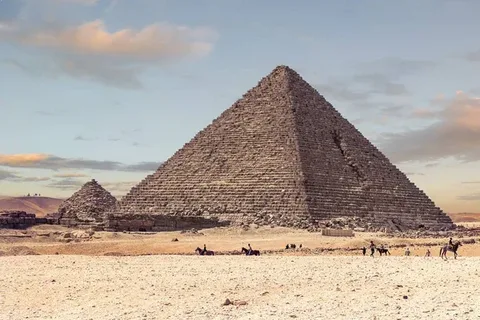
For more than 4,500 years, the pyramids of Giza have stood as some of humanity’s greatest engineering achievements. Millions of visitors travel to Egypt each year to admire their immense scale, while archaeologists continue searching for clues about the people who built them and the secrets they may still hold. Although the Great Pyramid of Khufu often dominates headlines, its smaller neighbor, the Pyramid of Menkaure, remains one of the most intriguing monuments on the Giza Plateau.
Unlike many ancient structures that have been heavily altered over time, Menkaure’s Pyramid still preserves valuable evidence about pyramid construction, royal burial practices, and the evolution of Egyptian architecture. Yet one question continues to fascinate researchers and history enthusiasts alike: could there still be undiscovered spaces hidden inside?
Modern technology has transformed the search for answers. Instead of relying solely on excavation, scientists can now study ancient monuments using advanced imaging techniques that reveal internal structures without disturbing the stone itself. While no confirmed hidden chambers have been announced inside Menkaure’s Pyramid, researchers continue to investigate unusual features and structural anomalies that may help explain how the monument was designed and built.
Separating scientific evidence from internet speculation is becoming increasingly important. Viral headlines often promise “secret rooms” or “lost treasures,” but archaeology rarely works that way. Real discoveries are usually the result of years of careful research, testing, and peer review. Understanding what experts actually know makes the story even more fascinating.
A Quick Look at Menkaure’s Pyramid
Menkaure’s Pyramid is the smallest of the three principal pyramids at Giza, yet its historical importance is enormous. Built for the Pharaoh Menkaure during Egypt’s Fourth Dynasty, the monument reflects a period when pyramid construction had reached an extraordinary level of sophistication.
Although smaller than the pyramids of Khufu and Khafre, it was still an impressive feat of engineering. Much of its lower exterior was originally covered with polished granite, giving it a distinctive appearance that set it apart from neighboring pyramids.
Key facts about Menkaure’s Pyramid
| Feature | Details |
| Builder | Pharaoh Menkaure |
| Dynasty | Fourth Dynasty |
| Estimated completion | Around 2510 BCE |
| Original height | About 65 meters (213 feet) |
| Location | Giza Plateau, Egypt |
| Exterior material | Limestone with granite casing at the base |
Its smaller size has never made it less significant. In many ways, it offers archaeologists valuable insights into how pyramid design evolved over time.
What Is Inside the Pyramid Today?
Unlike fictional adventure stories, pyramids are not filled with endless hallways and hidden traps. Their interiors are generally straightforward, though remarkably well planned.
Menkaure’s Pyramid contains a descending entrance passage that leads visitors toward a series of chambers carved within the structure and beneath its foundation. These include corridors, an antechamber, and a burial chamber where the pharaoh’s sarcophagus was once placed.
Over the centuries, explorers documented these rooms, helping researchers build a clearer understanding of the pyramid’s layout.
Known internal features
- Entrance passage.
- Descending corridor.
- Antechamber.
- Burial chamber.
- Rock-cut passages beneath the pyramid.
- Structural support spaces.
While these rooms are well documented, archaeologists remain interested in whether other spaces may still exist beyond those already mapped.
Why Scientists Search for Hidden Spaces
People often assume archaeologists are searching for treasure, but modern research has very different goals.
Finding an unknown chamber could answer important questions about how the pyramid was constructed, whether architectural plans changed during building, or how ancient engineers managed the immense weight of millions of stone blocks.
Sometimes an empty chamber can be just as valuable as one containing artifacts because it reveals information about construction techniques.
Scientists look for hidden spaces to better understand:
- Building methods.
- Structural stability.
- Burial customs.
- Architectural planning.
- Ancient engineering solutions.
- Pyramid evolution.
Every new discovery contributes another piece to Egypt’s remarkable history.
Modern Technology Has Changed Everything
For much of archaeology’s history, discovering hidden rooms required excavation or physically entering dangerous spaces.
Today, researchers often begin with non-invasive technology that allows them to study monuments without causing damage.
These methods reduce risk while producing highly detailed images of internal structures.
Technologies used to study pyramids
| Technology | Purpose |
| Ground-penetrating radar | Detects changes beneath surfaces |
| Laser scanning | Creates accurate 3D models |
| Photogrammetry | Produces detailed digital reconstructions |
| Thermal imaging | Identifies temperature differences that may indicate voids |
| Muon tomography | Detects large internal spaces using cosmic-ray particles |
Many of these techniques have already helped researchers investigate other pyramids without removing a single stone.
What Is Muon Tomography?
Among the newest archaeological tools, muon tomography has received considerable attention.
Muons are tiny particles that constantly pass through Earth from space. Because they interact differently with solid stone than with empty space, scientists can measure how many pass through a structure to identify possible voids.
Think of it as a giant X-ray created by nature.
Instead of using artificial radiation, researchers observe naturally occurring cosmic particles.
Advantages of muon scanning
- Completely non-invasive.
- Safe for ancient monuments.
- Detects large internal cavities.
- Supports existing survey methods.
- Helps identify areas for future study.
The technique gained worldwide attention after researchers identified previously unknown voids inside the Great Pyramid of Khufu, demonstrating its remarkable potential for archaeological research.
Have Hidden Spaces Been Found Inside Menkaure’s Pyramid?
This is where many online headlines become misleading.
As of today, archaeologists have not confirmed the existence of newly discovered hidden chambers or secret voids inside Menkaure’s Pyramid comparable to the well-publicized void identified within the Great Pyramid.
That doesn’t mean researchers have stopped looking.
Instead, scientists continue studying the monument using increasingly sophisticated technologies to better understand its construction and identify any unusual structural features that deserve further investigation.
What experts currently agree on
| Statement | Current Evidence |
| Known internal chambers exist | Confirmed |
| Newly confirmed hidden chambers | Not confirmed |
| Scientific interest continues | Yes |
| Non-invasive scanning is ongoing | Yes |
| Further discoveries remain possible | Yes |
Archaeology rarely delivers instant answers. Most discoveries emerge gradually as evidence accumulates over many years.
Why Do Rumors About Secret Chambers Spread So Quickly?
Few ancient monuments capture people’s imagination like the pyramids. Every time researchers announce a new study, social media quickly fills with headlines claiming that hidden cities, treasure rooms, or mysterious tunnels have finally been found.
The reality is usually much less dramatic. Archaeologists work slowly because every claim must be supported by evidence. A small anomaly detected during scanning doesn’t automatically mean a secret chamber exists.
Why these stories go viral
- Ancient Egypt has fascinated people for centuries.
- Mystery attracts more clicks than certainty.
- Scientific discoveries are sometimes exaggerated online.
- New scanning images can be misunderstood.
- Movies and documentaries fuel public imagination.
This is why it’s important to distinguish between confirmed discoveries and ongoing research.
What Could Hidden Spaces Tell Us?
Finding an unknown space inside Menkaure’s Pyramid would be exciting, but not necessarily because of hidden treasure.
Even an empty chamber could reveal valuable information about how the pyramid was built, how workers managed structural weight, or whether construction plans changed while the monument was being completed.
Possible insights include:
- Construction techniques.
- Engineering solutions.
- Weight distribution systems.
- Changes in architectural design.
- Burial traditions during the Fourth Dynasty.
For archaeologists, knowledge is often more valuable than artifacts.
Comparing Menkaure’s Pyramid With the Other Giza Pyramids
The three main pyramids at Giza were built within the same dynasty, yet each has its own architectural characteristics.
Studying them together helps researchers understand how pyramid design evolved over time.
| Pyramid | Pharaoh | Approximate Height | Known For |
| Khufu | Khufu | 146.6 m originally | Largest pyramid and recently discovered large internal void |
| Khafre | Khafre | 143.5 m originally | Appears tallest because of higher ground |
| Menkaure | Menkaure | 65 m originally | Granite casing and smaller but sophisticated design |
Although Menkaure’s Pyramid is the smallest of the three, it continues to provide valuable archaeological evidence.
Challenges Researchers Face
Studying a monument that’s over four millennia old isn’t simple.
Scientists must balance curiosity with preservation. Every investigation needs to protect the pyramid while still gathering useful information.
Modern technology helps, but interpreting the data remains a complex process.
Common research challenges
- Protecting fragile ancient structures.
- Distinguishing natural gaps from man-made spaces.
- Limited access to some areas.
- Environmental conditions affecting equipment.
- Verifying results before making announcements.
These challenges explain why archaeological research often takes years rather than months.
Why Preservation Matters More Than Excavation
Years ago, archaeology often involved digging first and asking questions later.
Today’s researchers take a very different approach. Preserving ancient monuments has become just as important as studying them.
Instead of opening new passages unnecessarily, scientists now prefer methods that leave the structure untouched.
Benefits of non-invasive research
| Traditional Excavation | Modern Survey Methods |
| Physical digging | Digital scanning |
| Higher risk of damage | Minimal disturbance |
| Permanent alterations | Preserves original structure |
| Limited coverage | Large-scale mapping |
| Slower documentation | Detailed digital records |
This approach helps protect Egypt’s cultural heritage for future generations.
Could Future Technology Reveal More?
Absolutely.
Every decade brings new tools capable of collecting more accurate data than the generation before.
As imaging technology improves, researchers may identify architectural details that are currently impossible to detect.
Future advancements may include:
- Higher-resolution scanning.
- Faster 3D mapping.
- AI-assisted image analysis.
- Improved particle detection.
- Better structural modeling.
Future discoveries may not come from excavation at all. They may begin with a computer screen.
What Menkaure’s Pyramid Still Teaches Us
Even without newly discovered hidden chambers, Menkaure’s Pyramid remains an extraordinary source of knowledge.
It helps archaeologists understand royal architecture, engineering, construction planning, and the remarkable skills of ancient Egyptian builders.
Every survey, measurement, and digital scan adds another piece to that story.
Sometimes the greatest discoveries aren’t dramatic headlines. They’re the gradual improvements in our understanding of one of history’s greatest civilizations.
Frequently Asked Questions
1. Have scientists found hidden chambers inside Menkaure’s Pyramid?
No. At present, archaeologists have not confirmed any newly discovered hidden chambers or large internal voids inside Menkaure’s Pyramid.
2. Why do people think there are secret rooms?
Modern scanning technologies sometimes detect unusual structural features, which can lead to speculation before researchers complete their analysis. Online headlines often exaggerate these findings.
3. What technology is used to study pyramids today?
Researchers commonly use laser scanning, thermal imaging, ground-penetrating radar, photogrammetry, and muon tomography to investigate ancient monuments without damaging them.
4. Why is Menkaure’s Pyramid important?
Although it is the smallest of the three major pyramids at Giza, it provides valuable insight into Fourth Dynasty architecture, engineering techniques, and royal burial traditions.
5. Could hidden spaces still exist?
It’s possible. Archaeologists remain open to new discoveries, but any claim must be supported by strong scientific evidence before it is accepted.
Conclusion:
Menkaure’s Pyramid continues to inspire curiosity because it represents both an extraordinary achievement of ancient engineering and a puzzle that researchers are still working to understand. While no newly confirmed hidden chambers have been discovered inside the pyramid, modern technology is giving scientists better ways to study its structure without causing harm. Each new scan and every careful investigation brings us a little closer to understanding how one of Egypt’s greatest monuments was designed more than 4,500 years ago.
Call to Action
If ancient Egypt fascinates you, keep an eye on ongoing archaeological research rather than sensational headlines. The most exciting discoveries often come from years of careful scientific work, and following trusted research can give you a deeper appreciation of how history continues to unfold one finding at a time.