

The Black Death is often described with staggering numbers. Historians estimate that tens of millions of people died across Europe, Asia, and North Africa during the pandemic that swept through the 14th century. While those figures help us understand its scale, they don’t fully capture the human experience of living through one of history’s deadliest outbreaks.
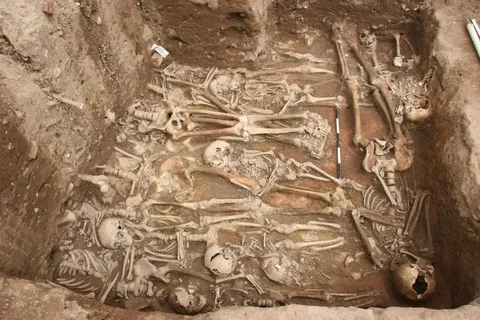
That perspective comes from archaeology. Every excavation of a medieval plague cemetery offers a direct connection to the people who lived, suffered, and died during the pandemic. Beneath layers of soil, archaeologists uncover carefully arranged skeletons, burial objects, and traces of communities struggling to cope with unimaginable loss.
Mass graves may sound chaotic, but many tell a different story. Instead of evidence of panic or abandonment, they often reveal organized efforts to bury victims respectfully despite overwhelming circumstances. Combined with modern DNA analysis and forensic science, these sites have become invaluable sources of information about the disease that transformed medieval society.
Today, researchers continue studying plague cemeteries across Europe to answer questions that written records alone cannot. How quickly did the disease spread? Who was most affected? Did communities completely collapse, or did they adapt? The answers are reshaping our understanding of one of history’s most devastating pandemics.
Understanding the Black Death
The Black Death reached Europe in the mid-14th century and spread with astonishing speed through trade routes connecting continents.
The disease was caused by the bacterium Yersinia pestis, which was commonly carried by fleas living on rodents. As trade expanded between regions, infected rodents and fleas traveled with merchants, helping the disease move from city to city.
Key facts about the Black Death
| Feature | Details |
| Main outbreak | 1347 to 1353 |
| Cause | Yersinia pestis bacterium |
| Transmission | Fleas, rodents, and in some cases human-to-human spread |
| Estimated deaths | Tens of millions worldwide |
| Regions affected | Europe, Asia, North Africa |
Although outbreaks continued for centuries, the first wave remains the deadliest.
Why Archaeologists Study Mass Graves
Written records describe fear, illness, and widespread death, but documents rarely tell the whole story.
Mass graves provide physical evidence that helps researchers verify historical accounts. Every skeleton, burial position, and artifact contributes another piece to the puzzle.
Rather than searching for treasure, archaeologists carefully document each burial to understand how communities responded during the crisis.
Information gained from plague cemeteries
- Estimated age of victims.
- Health before infection.
- Burial practices.
- Population demographics.
- Evidence of nutrition.
- Signs of previous diseases.
- Community responses during outbreaks.
Each discovery helps historians reconstruct everyday life during one of history’s darkest periods.
Were Mass Graves Simply Pits of Chaos?
Movies often portray plague burials as hurried scenes where bodies were thrown into enormous pits without care.
Excavations tell a more nuanced story.
Many plague cemeteries show evidence that victims were placed in orderly rows. Bodies were often positioned carefully, suggesting that even during overwhelming mortality, communities tried to preserve dignity and religious traditions.
Common characteristics of plague burials
| Feature | Archaeological Evidence |
| Bodies arranged carefully | Frequently observed |
| Multiple individuals per grave | Common |
| Religious orientation | Often maintained |
| Grave goods | Usually limited |
| Signs of violence | Rare |
These findings challenge the assumption that medieval society completely descended into disorder.
One of the Most Important Discoveries: East Smithfield
Among the best-known plague cemeteries is the East Smithfield burial ground in London.
Created specifically during the Black Death, the cemetery was established because existing churchyards could no longer accommodate the growing number of victims.
Excavations have provided researchers with one of the clearest archaeological records of a plague cemetery anywhere in the world.
Why East Smithfield matters
- Burials date directly to the Black Death.
- Skeletons are exceptionally well preserved.
- Thousands of individuals have been studied.
- DNA analysis confirmed plague bacteria.
- Burial organization reflects emergency planning.
The site continues to shape modern research into medieval disease.
Ancient DNA Changed Everything
For many years, historians debated whether the Black Death was truly caused by Yersinia pestis.
That question was largely settled through ancient DNA research.
Scientists extracted genetic material from the teeth of plague victims and identified DNA belonging to the bacterium. This breakthrough confirmed that medieval plague victims were infected with the same organism responsible for later plague outbreaks.
How scientists recover ancient DNA
- Carefully excavate skeletal remains.
- Select well-preserved teeth.
- Remove contamination.
- Extract DNA in specialized laboratories.
- Compare genetic sequences with modern samples.
Ancient DNA has become one of archaeology’s most powerful research tools.
What Skeletons Reveal Beyond the Disease
Not every answer comes from DNA.
Human bones preserve evidence of a person’s life long before infection occurred.
Researchers can identify nutritional deficiencies, healed injuries, arthritis, physical labor, and even childhood stress.
Information preserved in skeletal remains
| Evidence | What It Can Reveal |
| Teeth | Diet, disease, age |
| Bones | Physical activity |
| Joint wear | Occupation and lifestyle |
| Fractures | Previous injuries |
| Growth patterns | Childhood health |
This allows archaeologists to study not only how people died but also how they lived.
Did the Black Death Affect Everyone Equally?
Historical accounts sometimes suggest that plague killed people at random.
Modern research paints a more complicated picture.
While the disease infected individuals across every social class, factors such as nutrition, existing health conditions, and living environments likely influenced survival.
Children, older adults, and those already weakened by illness often faced greater risks.
At the same time, wealthy families were not immune. The Black Death crossed social boundaries in ways few diseases had before.
How Mass Graves Changed Our Understanding of Medieval Society
Mass graves do more than document death. They also reveal how communities responded under extraordinary pressure.
Instead of abandoning social customs, many towns adapted. Temporary cemeteries were created, burial teams were organized, and local authorities tried to maintain order despite the overwhelming number of deaths.
These discoveries challenge the long-held belief that medieval society collapsed entirely during the pandemic.
What archaeologists have learned
- Communities continued organized burials.
- Religious traditions were often preserved.
- Emergency cemeteries were carefully planned.
- Local officials responded quickly in many cities.
- Families still tried to honor loved ones whenever possible.
The archaeological record shows resilience alongside tragedy.
How the Black Death Reshaped Europe
The effects of the plague didn’t end when the outbreak slowed.
With millions of people gone, labor became scarce. Workers suddenly had greater bargaining power, and many demanded higher wages or better conditions.
Entire economies shifted as populations struggled to recover.
Major changes after the pandemic
| Area | Impact |
| Labor | Worker shortages increased wages |
| Agriculture | Less land was cultivated |
| Cities | Population declined before gradual recovery |
| Economy | Trade patterns changed |
| Society | Existing social structures were challenged |
Many historians believe these changes helped reshape Europe for generations.
The Role of Modern Technology
Today’s archaeologists use tools that would have seemed impossible just a few decades ago.
Instead of relying only on excavation, researchers combine several scientific techniques to study plague cemeteries while preserving as much information as possible.
Each method contributes a different piece of evidence.
Technologies used in plague research
- Ancient DNA sequencing.
- Carbon dating.
- CT scanning.
- 3D digital mapping.
- Stable isotope analysis.
- Geographic Information Systems (GIS).
Together, these tools provide a much clearer picture of medieval life and death.
Common Myths About Plague Mass Graves
Popular culture has created many misconceptions about plague burials.
Films and novels often favor dramatic storytelling, but archaeology frequently tells a different story.
Myth vs. Reality
| Myth | Reality |
| Bodies were thrown into pits randomly. | Many graves show careful organization. |
| Every victim died alone. | Families and communities often remained involved in burials. |
| Archaeologists only search for treasure. | Their focus is understanding history through evidence. |
| Every mass grave belongs to the Black Death. | Many are linked to wars, famine, or other epidemics. |
| Scientists know everything about the plague. | Many questions are still being researched. |
Separating fact from fiction helps us better appreciate the work of archaeologists and historians.
Why These Discoveries Still Matter Today
Studying the Black Death isn’t only about understanding the past.
The pandemic revealed how disease can transform societies, influence economies, and change the way communities respond to public health crises.
Those lessons remain relevant as scientists continue studying infectious diseases in the modern world.
Researchers also use historical evidence to improve models of disease transmission and population recovery.
Lasting lessons from plague archaeology
- Public health responses matter.
- Accurate records are invaluable.
- Scientific collaboration leads to better discoveries.
- Communities often show remarkable resilience.
- Archaeology can answer questions that written history cannot.
History doesn’t repeat itself exactly, but it often provides valuable perspective.
What Researchers Hope to Discover Next
Even after decades of study, plague archaeology continues to evolve.
New excavation sites are still being identified, while advances in genetic analysis allow scientists to examine ancient remains in greater detail than ever before.
Future discoveries may reveal how the disease evolved, how populations adapted over time, and why some communities recovered faster than others.
Areas of ongoing research include:
- Evolution of Yersinia pestis.
- Regional differences in mortality.
- Long-term health effects on survivors.
- Migration after the pandemic.
- Environmental factors influencing outbreaks.
Every new excavation adds another chapter to one of history’s most important scientific investigations.
Frequently Asked Questions
1. What caused the Black Death?
The Black Death was caused by the bacterium Yersinia pestis, which spread primarily through fleas carried by rodents. In some situations, the disease could also spread between people.
2. Why were mass graves used during the plague?
The number of deaths often exceeded the capacity of local churchyards. Communities created emergency cemeteries to bury victims respectfully while managing the crisis.
3. How do scientists know plague victims had Yersinia pestis?
Researchers have extracted ancient DNA from the teeth of skeletons buried in plague cemeteries, confirming the presence of the bacterium.
4. Are new plague mass graves still being discovered?
Yes. Archaeologists continue to uncover medieval burial sites across Europe, providing fresh opportunities to study the Black Death and its impact on different communities.
5. Why is the East Smithfield cemetery so important?
Because it was created specifically during the Black Death, East Smithfield offers one of the clearest archaeological records of how a medieval city responded to the pandemic.
Conclusion:
Medieval mass graves are far more than silent reminders of a devastating pandemic. They preserve the stories of ordinary people, reveal how communities responded to extraordinary hardship, and provide scientific evidence that continues to reshape our understanding of the Black Death. With every excavation and every DNA analysis, archaeologists move a little closer to understanding not only how millions died but also how humanity endured one of history’s greatest challenges.
Call to Action
If you’re fascinated by archaeology, ancient history, or the science behind historical discoveries, follow ongoing research from trusted museums and academic institutions. Every new excavation has the potential to answer old questions and uncover stories that have remained hidden for centuries.